MSc Research Project
Giant-Planet Magnetospheres.
Investigating plasma leakage through the magnetospheric boundaries of Jupiter and Saturn
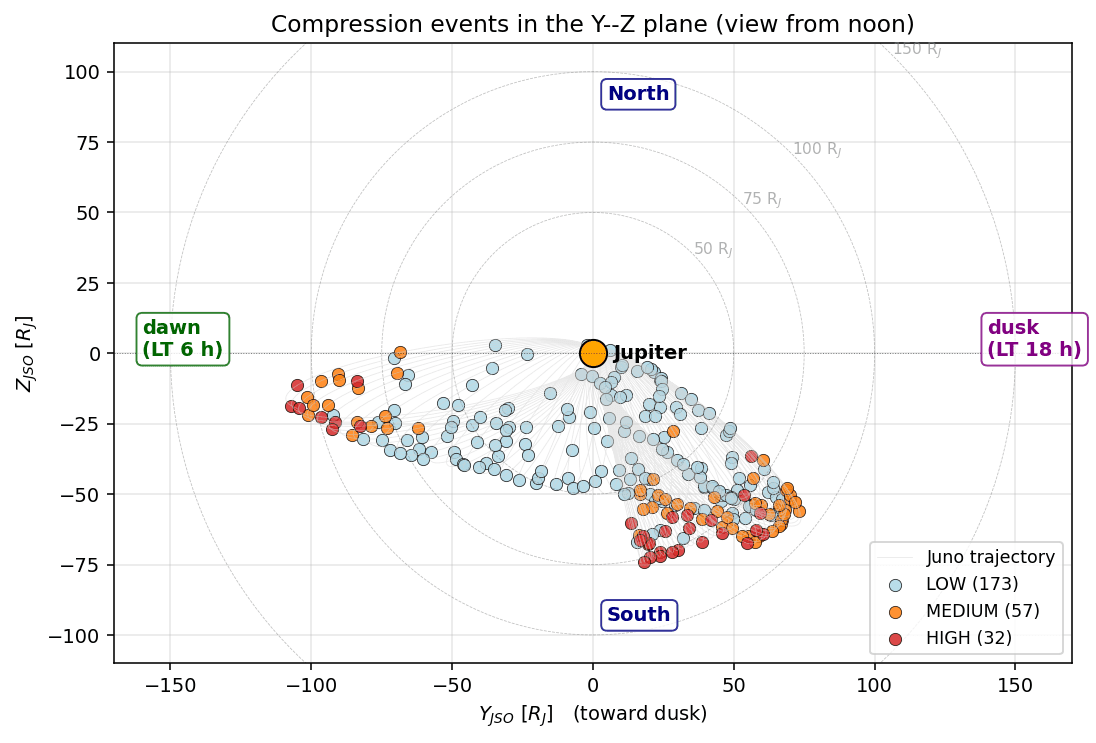
- Compression events catalogued
- 262
- Ranked high-priority
- 32
- Detection precision
- 66.7%
- Conference poster
- MOP 2026
Does plasma from inside Jupiter’s magnetosphere leak out across its boundaries? A research project using Juno spacecraft data.
The problem
Jupiter has the largest magnetosphere in the Solar System, and unlike Earth’s, much of its plasma comes from inside it. This internal plasma is carried outward toward the magnetospheric boundaries. Our project investigates whether this plasma actually leaks across the magnetopause, by looking for heavy ions of internal origin outside the magnetosphere: in the magnetosheath and in the solar wind.
An internal plasma source: Io
Io, Jupiter’s volcanically active moon, is the main internal plasma source. Its sulphur-dioxide atmosphere loses more than a tonne of gas per second. Once ionised, this gas forms a torus of plasma that follows Io’s orbit and corotates with Jupiter’s 10-hour spin. The torus holds about 2 megatons of mostly S⁺ and O⁺ ions. Jupiter’s fast rotation then pushes this heavy plasma outward, through flux-tube interchange driven by centrifugal forces.
Because sulphur and oxygen ions come mainly from Io and are rare in the solar wind, they work as a tracer. If we find them outside the magnetopause, that is evidence the plasma has leaked out.
What we did
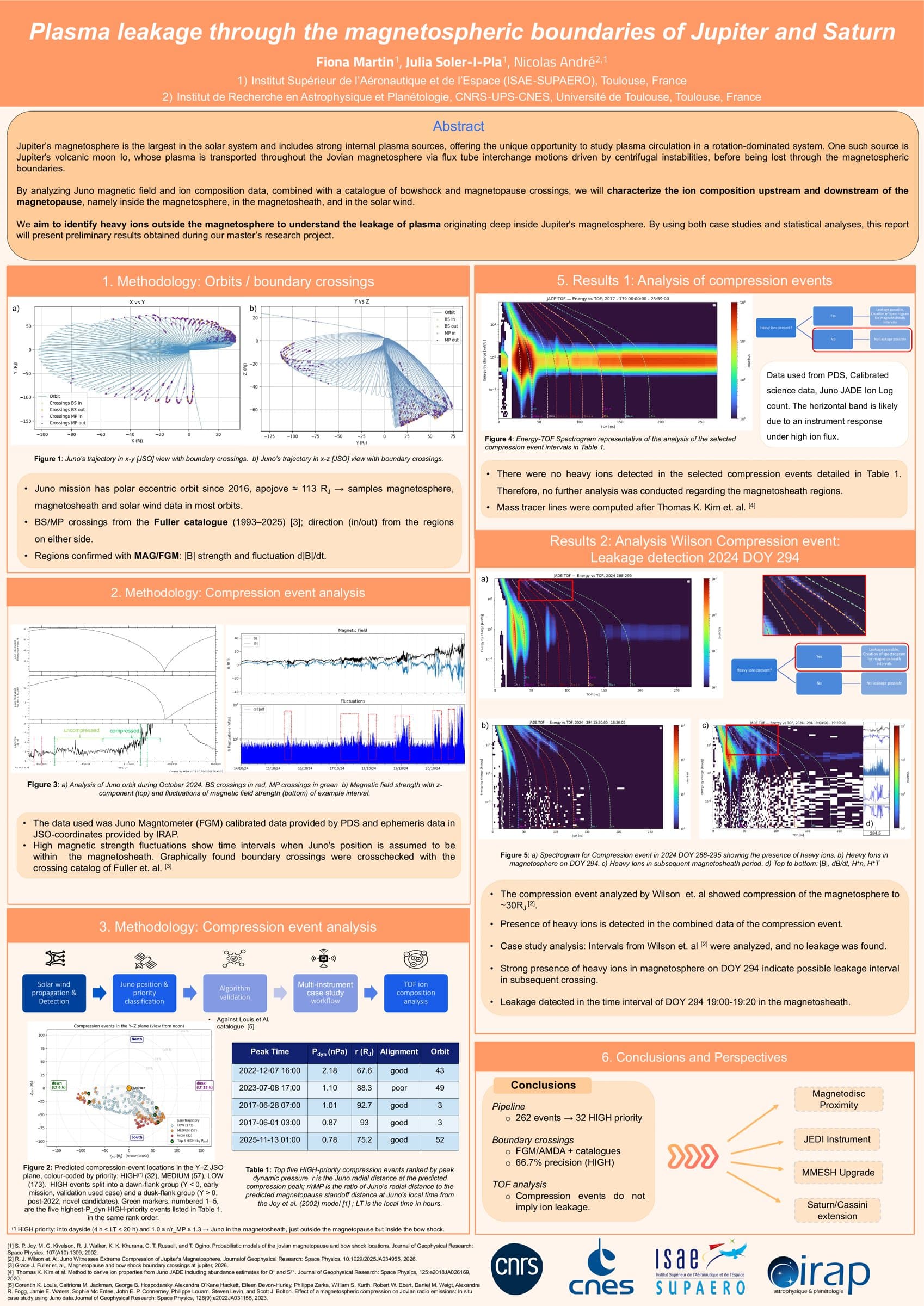
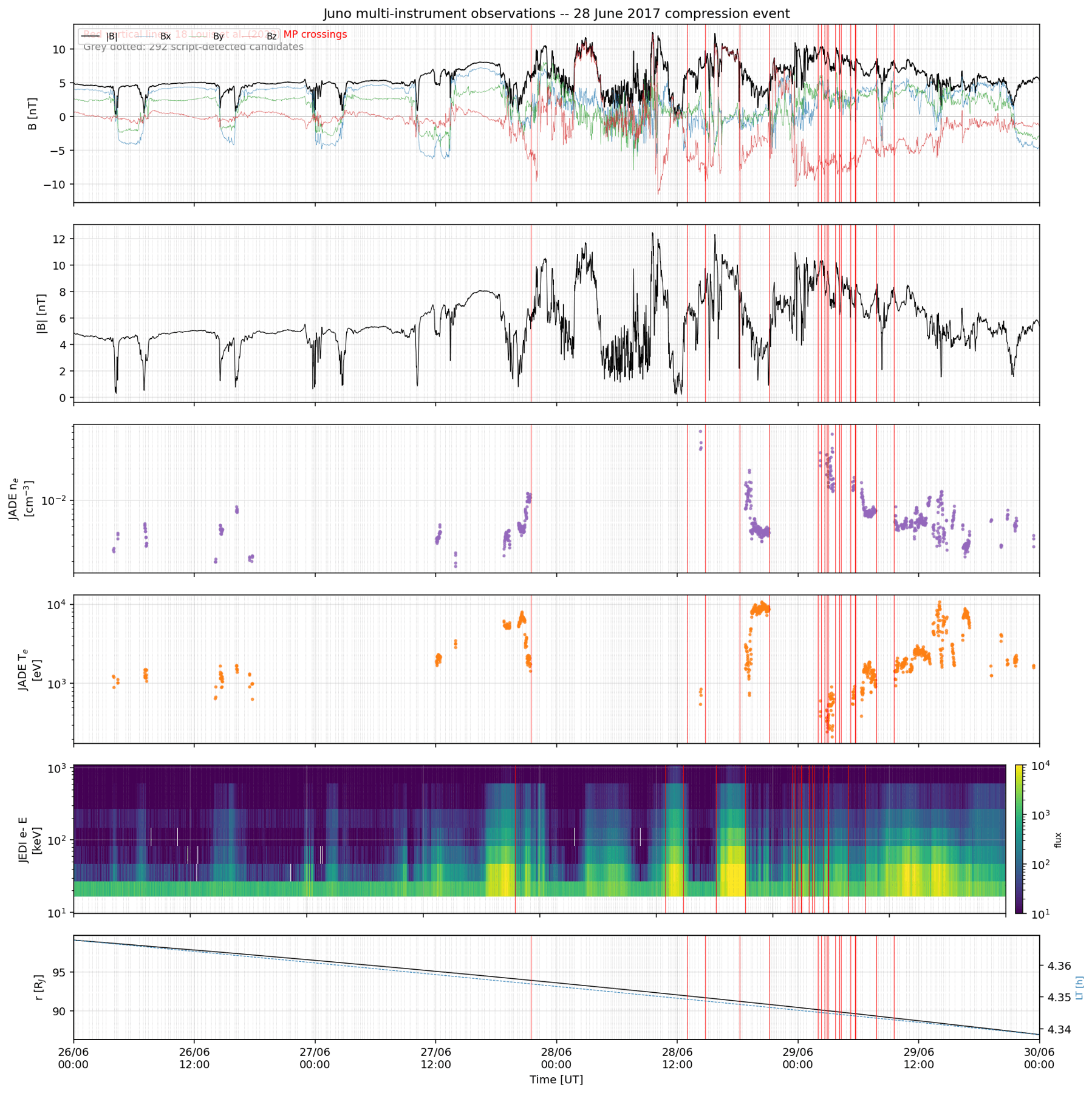
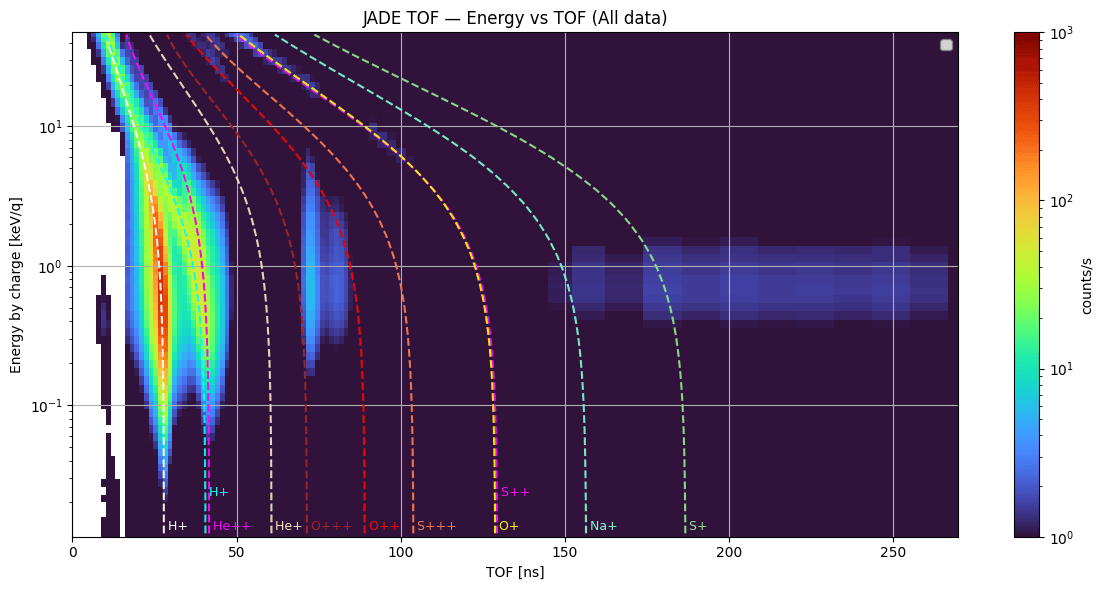
We combine Juno magnetometer (FGM) data and JADE-I ion composition data with catalogues of bow-shock and magnetopause crossings. Solar-wind compression events push the magnetopause inward, so they are the best moments to catch Juno just outside the boundary. We built a pipeline that propagates the solar wind out to Jupiter, detects compression events, and ranks them by Juno’s position. We validated it against the Louis et al. (2023) catalogue. Time-of-flight spectrograms then show whether heavy ions are present on each side of the boundary.
Highlights
- 01Combined Juno magnetometer (FGM) and ion composition (JADE-I) data with catalogues of bow-shock and magnetopause crossings
- 02Built a pipeline that detects and ranks solar-wind compression events, validated against Louis et al. (2023)
- 03Used heavy sulphur and oxygen ions of Io origin as a tracer of leakage
- 04Identified a candidate leakage interval on 21 October 2024, between 19:00 and 19:20
Results
In most compression events we found no heavy ions outside the magnetosphere, so a compression alone does not imply leakage. In the extreme compression of October 2024, however, heavy ions appear in the magnetosheath on day 294 (21 October), between 19:00 and 19:20: a candidate leakage interval.
Next steps: add JEDI energetic-particle data, and extend the study to Saturn with Cassini data. Saturn’s internal source is the moon Enceladus.
Outcome
We presented this work as a poster at MOP 2026, the Magnetospheres of the Outer Planets conference, in Toulouse, 26–31 July 2026.