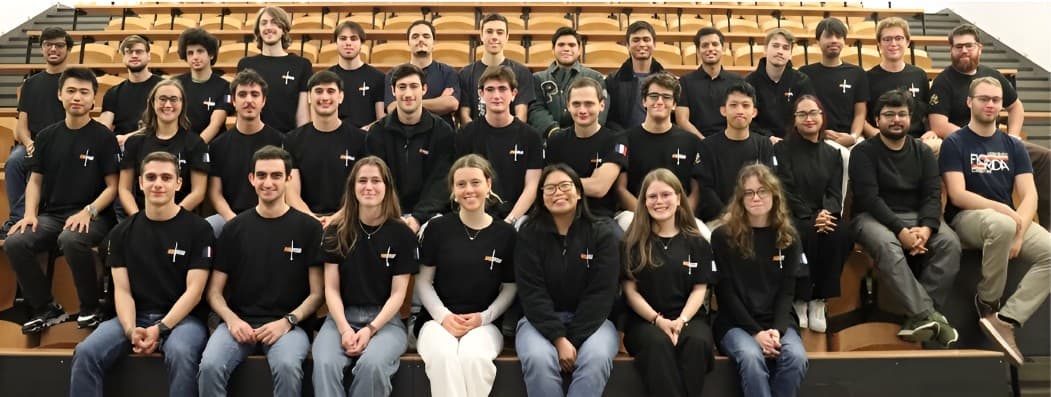
Supaero Space Section
Rocket Avionics.
Avionics for Sunspear, a 9,000 m-apogee competition rocket
- Target apogee
- 9,000 m
- Target competition
- EuRoC 2026
- Team members
- 33
- Custom flight-computer PCB
- 4-layer
Flight computer, sensors and telemetry for Sunspear, a student rocket aiming to become France’s first student-built supersonic rocket, targeting EuRoC 2026.
The problem
With the Supaero Space Section, the student space club at ISAE-SUPAERO, I’m part of the Sunspear team building a competition rocket that aims to become France’s first student-built supersonic rocket, targeting the 9,000 m-apogee category at EuRoC 2026.
What I did
As an avionics engineer, I designed and tested the avionics subsystem: a custom four-layer PCB built around an ESP32-S3 flight computer, with separate power domains for the logic and the pyrotechnic circuits. The flight software runs on FreeRTOS as a finite-state machine — startup, idle, boost, coast, drogue, main and landed, plus an abort state — with altitude estimated by a Kalman filter fusing barometer and IMU data, pyrotechnic channels with continuity sensing, and telemetry sent over an 868 MHz LoRa link to a ground station. I managed the hardware/software integration, with a focus on reliability under high-g launch conditions, within a 33-person student team.
Highlights
- 01Custom four-layer flight-computer PCB built around an ESP32-S3
- 02Flight software finite-state machine on FreeRTOS, from startup through landing
- 03Altitude estimation via a Kalman filter fusing barometer and IMU data
- 04Telemetry over an 868 MHz LoRa link to a ground station
Outcome
The team is preparing Sunspear for EuRoC 2026, aiming to become France’s first student team to fly a supersonic rocket.
Team